
Data Warehouse and Business Intelligence
Every dashboard we've ever been called in to fix was really a data platform problem underneath. Wrong totals, history that vanished when a customer moved city, three definitions of revenue. This twelve-week course…
Course description
Every dashboard we've ever been called in to fix was really a data platform problem underneath. Wrong totals, history that vanished when a customer moved city, three definitions of revenue. This twelve-week course teaches you to build the platform properly, a warehouse that pulls from many operational systems, keeps history correctly, tests itself and serves fast, trustworthy numbers to Power BI. It's for analysts who want to move into BI engineering, data engineering or analytics engineering roles, at banks and telecoms here or remotely for firms abroad.
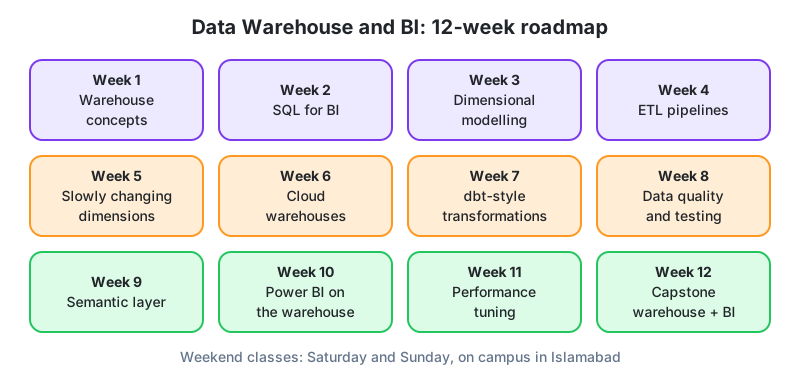
We work through one realistic retail-chain case from start to finish. Warehouse concepts and SQL for BI, dimensional modelling (star schemas, conformed dimensions, slowly changing dimensions), ETL and ELT pipelines, cloud warehouses such as Snowflake and BigQuery, dbt-style transformations with tests and docs, data quality gates, a semantic layer with governed metrics, Power BI wired to the warehouse the right way, and performance tuning. The capstone is a complete platform you build, document and present as you would to a client.
Classes are live on Saturdays and Sundays, on campus in Islamabad or online. Labs run on PostgreSQL and the free tiers of the cloud warehouses, so everything can be practised at home for nothing. You should already be comfortable with basic SQL and have used Power BI or something like it at least once.
What You'll Learn
Skills You'll Gain
Test Yourself
Profile operational sources
Explore the retail chain's POS, ERP and product API exports in PostgreSQL, write down grain, keys, volumes and quality problems, and propose which questions the warehouse must answer. You'll find the product API disagrees with the ERP on category. That's deliberate.
Hands-on Lab Task
Design and load a star schema
Model FactSales, DimDate, DimProduct, DimStore and DimCustomer at the right grain, generate surrogate keys and load them from staging with SQL.
Hands-on Lab Task
Implement a Type 2 dimension
Add valid_from, valid_to and is_current to DimCustomer, write the merge that closes old rows and inserts new versions, and prove with a query that a customer who moved from Lahore to Karachi still has last year's sales in Lahore.
Hands-on Lab Task
Build an incremental pipeline with batch control
Create a batch control table, load only new or changed rows each run, make the load safe to rerun and log row counts and status for every step.
Hands-on Lab Task
Add dbt-style models and tests
Split transformations into staging, intermediate and mart models, add not-null, unique and relationship tests, and generate lineage docs.
Hands-on Lab Task
Connect Power BI and tune it
Build a Power BI dataset over the marts, compare Import and DirectQuery, add an aggregation table and use query profiles to cut a slow report's time.
Hands-on Lab Task
Curriculum
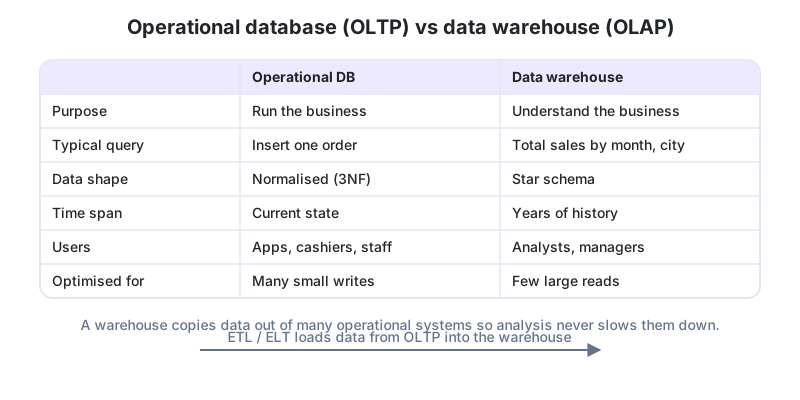
Why would a company copy data out of the systems that run the business into a separate database that runs nothing? New students ask this every batch, and it's the right question. This weekend gives you the vocabulary and the big picture, OLTP versus OLAP, the layers of a platform, and who does what on a data team.
What we cover
- Operational databases versus analytical warehouses, purpose, workload, shape of the data
- Warehouse architectures, staging, integration and presentation layers, data marts, lakehouses
- Batch versus streaming, ETL versus ELT, and the modern data stack in one diagram
- Roles, data engineer, analytics engineer, BI developer, analyst, and what each is paid for in Pakistan and abroad
- The course case study, a retail chain with POS, ERP and a product API
In the lab
Explore the case study's source exports in PostgreSQL, list the business questions the warehouse must answer and sketch a first architecture.
Bring back next week
A one-page architecture proposal with a source inventory, the target questions and a layered diagram.
Faisal Adnan
Lead Trainer, Code School of Analytics
Power BI, Data Warehousing & AI-assisted developmentFaisal leads CSA's Power BI, Data Warehouse and Vibe Coding programs, bringing a decade of hands-on BI and analytics consulting experience to every weekend batch.
10
Years Experience
6
Batches Taught
0
Students Mentored
Student Reviews
No reviews yet, be the first to enroll and share your experience.
Requirements
- Working SQL (SELECT, JOIN, GROUP BY). Our free SQL track or equivalent is enough
- Some time in Power BI or another BI tool. Hands-on Power BI is the natural lead-in
- A laptop with 8 GB RAM. PostgreSQL and free cloud tiers cover every lab
- Four to five hours a week outside class. The capstone is not a one-weekend job
Upcoming Batches
DWABI-Weekend-Onsite-01
Faisal Adnan · Starts 17 Oct 2026
Saturday & Sunday · 12 weeks
DWABI-Weekend-Online-01
Faisal Adnan · Starts 17 Oct 2026
Saturday & Sunday · 12 weeks
Fee by mode