
AI Inside the Analytics Stack: What Changes for Data Analysts in 2026
CSA Editorial Team · 15 Sept 2026

For a few years "AI for analysts" meant a chat window next to your work. Paste a query, ask for a fix, copy it back. That isn't what our graduates are walking into any more. AI features now live inside the data platform. In the pipeline tool that notices a broken load, in the transformation layer that writes and tests SQL, in the semantic layer that keeps metric definitions straight, and in the BI tool where a manager types a question in plain English and gets a governed answer. It's inside the stack, not beside it.
We rebuilt our data warehouse course around this over the past year, so what follows is opinion shaped by teaching it, not a vendor brochure.
Where AI sits, layer by layer
A modern analytics platform has four layers. Ingestion and storage, transformation, a semantic layer, and consumption. AI has found a job in each.
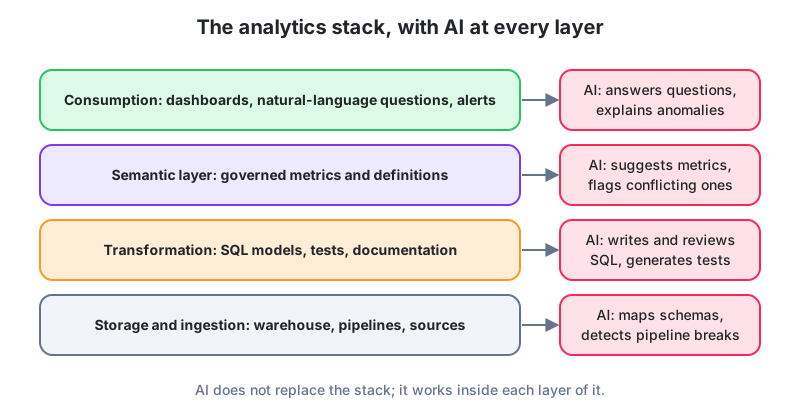
- Ingestion and storage. Assistants map new source schemas to existing tables, suggest data types and flag anomalies such as a file arriving with half the usual rows.
- Transformation. Coding agents write SQL models, generate tests for keys and ranges, document columns and propose refactors. A dbt-style project that once took a week to scaffold now takes an afternoon.
- Semantic layer. AI helps define metrics, spots two definitions of "revenue" that disagree, and reads the layer so that natural-language questions get answered with the official definitions rather than guesses.
- Consumption. Dashboards grow a chat box. "Why did Lahore sales drop in March?" returns a chart, a breakdown and a written explanation, with the SQL available for review. Alerts explain themselves instead of just firing.
Here's the pattern we keep pointing at in class. The trustworthy AI features all sit on top of good data engineering. Natural-language questions work when there's a semantic layer to ground them. Anomaly explanations work when the model is clean. AI amplifies a well-built stack and produces confident nonsense on a badly built one. We've demonstrated both live, on purpose, and the second one is the more memorable.
How the week changes
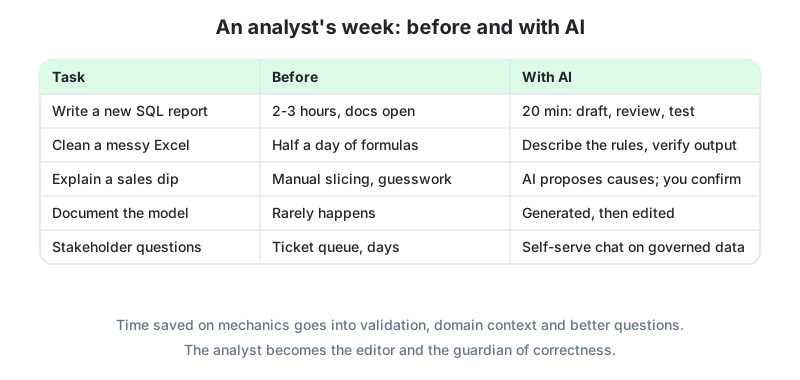
Talk to analysts at banks, telecoms and e-commerce companies and the same shifts come up. A new SQL report used to be hours with the documentation open. Now it's twenty minutes of drafting, reviewing and testing. Cleaning a messy Excel export means describing the rules and verifying the output rather than building formulas by hand. Explaining a sales dip starts from AI-proposed hypotheses that the analyst confirms or rejects against what they know about the business. Documentation, which nobody ever wrote, gets generated and edited. And the queue of "can you pull me the numbers for..." requests shrinks as stakeholders self-serve against governed data.
The saved time doesn't vanish. It moves into validation, into understanding the business more deeply, into asking better questions. The analyst becomes the editor and the guardian of correctness instead of the typist of queries. Honestly, that's the job most of them wanted in the first place.
What hasn't moved
A handful of things haven't changed, and together they define the job.
Knowing what the data means. AI can join two tables. It can't know that the "status" column changed meaning after a system migration in 2024, or that returns at a Faisalabad textile exporter get recorded a month late. That context lives with people, and the analysts who collect it and write it down become very hard to replace.
Deciding what to measure. Whether a Daraz seller should track gross orders or orders net of cancellations is a judgement about the business, not a query.
Verification. AI-generated SQL can be subtly wrong. A left join that should be inner. A filter applied before the aggregation instead of after. Someone has to check numbers against an independent source. In our courses this isn't negotiable, and students who skip it lose marks even when the number happens to be right.
Privacy. Pakistani data sets increasingly hold phone numbers, CNICs and transaction histories. Deciding what may be sent to an AI service, what must be masked and who may see what is a human responsibility, and regulators here are starting to care.
Communication. A chart isn't a decision. Explaining to a branch manager in Multan what the numbers mean and what to do next is still a people skill.
The skill map we teach to
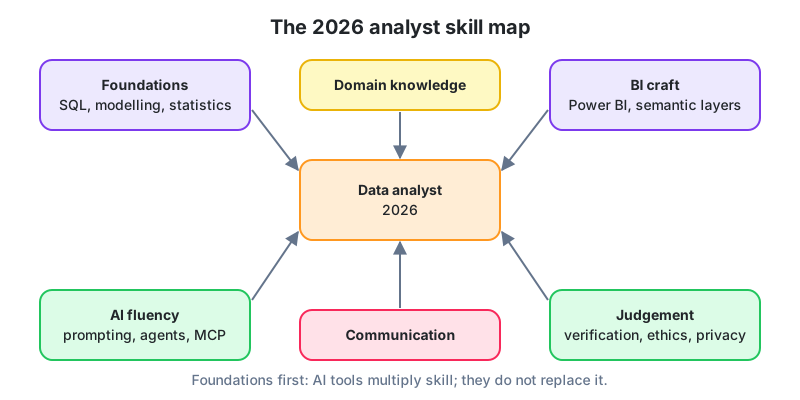
The profile employers ask for has six parts. Foundations in SQL, data modelling and basic statistics, because they let you judge AI output. BI craft, meaning Power BI or similar plus an understanding of semantic layers. AI fluency, which covers prompting, working with agents, and connecting models to data through standards such as MCP. Judgement, meaning verification habits and privacy. Domain knowledge in a sector like banking, telecom, retail or education. And communication.
Four of the six were on the list five years ago. AI fluency is new and judgement got heavier, but the foundation didn't change. That's why our tracks still start with SQL, Python and modelling before any AI tooling appears. The tools multiply skill. They don't replace it, whatever the ads say.
What to do about it
The demand side is encouraging. Banks, telecoms, fintechs and e-commerce companies here are building or rebuilding their data platforms, and overseas employers hire Pakistani analysts remotely because the mix of skill and cost is hard to beat. AI doesn't shrink the need for analysts in these places. It raises the bar for what one analyst is expected to deliver, and rewards those who can deliver more in the same hours.
Three practical steps. Learn SQL and data modelling thoroughly, because every AI feature in the stack depends on them and every interview still tests them (the free SQL track is where we send everyone). Use AI tools from day one of your learning, but reproduce at least one result by hand so you know what correct looks like. Then build one portfolio project on realistic local data, a JazzCash-style transaction set, a school's results, a distributor's sales, showing an end-to-end pipeline, a governed metric and a dashboard with a natural-language layer on top. That single project covers every part of the skill map, and it's the one interviewers in Karachi ask to see.
The analysts who'll do best over the next few years aren't the ones who fear AI or the ones who hand their thinking to it. They're the ones who understand the data well enough to use AI confidently and catch it when it's wrong.
Quick recap
AI now works in every layer of the analytics stack and is only as reliable as the platform under it. Analyst time is shifting from writing queries to validating, contextualising and explaining. Meaning, metric choice, verification, privacy and communication stay with people. Master SQL and modelling, use AI daily with verification, and build one end-to-end project on local data.