
Reasoning Models Explained: Why AI Now 'Thinks' Before It Answers
CSA Editorial Team · 21 Sept 2026
A student in our Saturday batch once asked why the assistant on her phone "gets stuck thinking" on some questions and answers others instantly. Fair question. That pause isn't a loading screen. The model is working through the problem in a private scratchpad before it commits to a reply. Models built to do this are called reasoning models, and in our view they're the quietest big change in AI of the past two years. Nobody puts them on a billboard, but they're the reason coding agents stopped falling over halfway through a task.
Two ways to answer
An ordinary language model writes its reply one token at a time, straight from the question. That's fine for rewriting a paragraph, summarising, translating or chatting. For anything with dependent steps, a multi-part calculation, a stubborn bug, a timetable with constraints, answering directly is like a student blurting out the final number with no working shown. Sometimes right. Often undone by a small slip in step two.
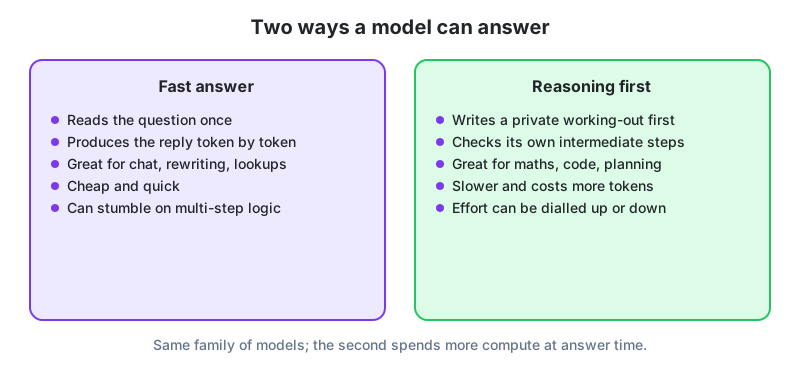
A reasoning model does something different. Before it writes the visible answer it generates a hidden run of intermediate steps. Restate the problem, split it up, try an approach, check it, sometimes back up and try again. Only then does it reply. You might see one sentence. Behind it might be pages of private working.
The idea isn't new. Years ago researchers noticed that asking a model to "think step by step" improved accuracy on maths and logic. What's changed is that models are now trained specifically to reason well, learning through feedback on many problems which kinds of working lead to correct answers. The result plans, verifies and self-corrects far more reliably than a model that has merely been asked to show its steps.
A fee calculation, done properly
Here's the kind of question we put on the board in week one. A student pays a PKR 25,000 onsite fee in four instalments and gets a 10% early-bird discount. What's each instalment?
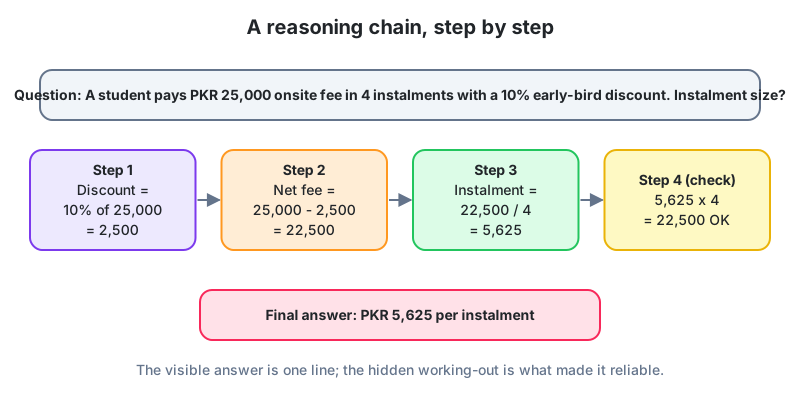
A reasoning model works it through. Discount is 2,500, net fee is 22,500, divided by four is 5,625, multiply back and it matches. Visible answer, "PKR 5,625 per instalment." Trivial here, but the same behaviour scales to debugging a data pipeline, planning a database migration or checking whether a statistical argument actually holds.
The check at the end is the part we care about. Fast models almost never verify. Reasoning models are trained to, and that's where most of the reliability comes from. We tell students to copy that habit whether or not a machine is involved.
Where reasoning pays off
Across the industry the biggest gains have landed in a consistent set of places, and what we see in class matches.
- Maths and quantitative work. Multi-step calculations, unit conversions, financial models, statistics homework.
- Code. Finding the real cause of a bug instead of patching the symptom, handling edge cases, refactoring without breaking things.
- Planning. Turning a big goal into ordered steps, which is exactly what an agent has to do.
- Constraint problems. Scheduling, eligibility checks, anything where several rules must hold at once.
- Catching their own errors. Because they check intermediate results, they present confident nonsense less often.
There's also a dial. Most reasoning models let the developer choose how much effort to spend, a little for quick tasks, a lot for hard ones. So "reasoning" is less a separate product than a setting you turn up when the problem deserves it.
Where it's a waste of money
Reasoning isn't free. Every hidden step costs time and tokens, so these models are slower and pricier per answer. For a chat reply, a rewrite or a simple lookup, the fast model is better, cheaper and just as accurate. Reasoning also doesn't fix missing knowledge. A model that has never seen your company's data will reason carefully to a wrong conclusion if the inputs are wrong. And a long chain of thought can still hide one bad step, so anything that matters still gets checked.
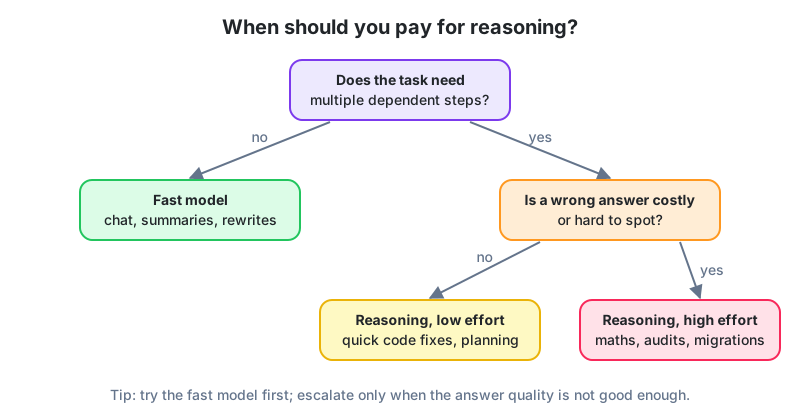
The rule we teach is simple. Start with the fast model. If the quality isn't good enough, or the task has dependent steps, or a wrong answer would be expensive to catch, turn reasoning on. Push the effort up only for the hardest work, audits, migrations, proofs. One of our students burned through a month's API credit in a weekend by leaving high effort on for every file rename. Don't be that student.
Why agents needed this
Reasoning and agents are two halves of one story. An agent that acts in the world has to plan, and planning is reasoning. Better reasoning is the main reason agents became reliable enough for real work. They can hold a long task in mind, notice when a tool result doesn't fit the plan, and change course. Watch a coding agent read three files, form a hypothesis, test it and revise, and you're watching a reasoning model at work.
For learners in Pakistan
Reasoning models raise the ceiling for one person studying alone. A student preparing for a statistics exam in Peshawar can ask for a checked, step-by-step derivation, then paste in their own attempt and ask where it went wrong. Used that way it's a patient tutor available at midnight. Used badly, by copying the final answer, it teaches nothing. Same tool. The difference is entirely you.
Writing a good problem statement now matters more. These models reward precise questions with the right context. Learning to state a problem clearly, with the data, the constraints and what a correct answer looks like, is a core skill, and it happens to be the same skill that makes a good analyst.
Verification is still your job. In our data courses every number produced with AI help gets checked against an independent calculation, a pivot table or a known total. Reasoning makes errors rarer, not impossible, and an analyst at a Karachi bank who ships an unchecked figure still owns it.
Cost awareness is a professional skill here too. Pakistani employers watch API bills closely, and knowing when a task needs an expensive reasoning call versus a cheap fast one is exactly the judgement they pay for. We cover the trade-off in the vibe-coding and AI-in-analytics sessions, and if you want to build the underlying step-by-step habit first, the free Python track is a good place to start.
Quick recap
Reasoning models think in a hidden scratchpad and check their steps before answering. They shine at maths, code, planning and constraint-heavy work. They cost more, so default to fast and turn reasoning on when it earns its keep. They're the foundation that made agents practical. And for you, the habits that matter are clear problem statements, learning from the steps, and always verifying.