
Vibe Coding: How AI Agents Are Changing Who Gets to Build Software
CSA Editorial Team · 18 Sept 2026

A school administrator in Islamabad needed to track which students had paid fees for which month. In 2022 that meant a messy spreadsheet or hiring a developer for a few weeks. This year she described the problem to an AI coding agent on a Saturday afternoon, tested it with real names on Sunday, and had staff using it on Monday. She has never written a line of code. She has, though, become very good at explaining what she wants and checking whether she got it.
That's vibe coding. Describe the intent, run what the agent builds, steer with feedback. The phrase started as a joke about coding without looking at the code. We've taught it to several batches now and we've stopped laughing. It works, it's here, and it goes wrong in predictable ways.
What changed, in two sentences
Coding agents became genuinely capable, able to read a whole project, plan a change, write it across files, run the tests, read the errors and fix them before you see the result. And the surrounding tools became friendly, with one-click deployment, hosted databases and frameworks the agents know well. Together they removed most of the setup work that used to sit between an idea and a working page.
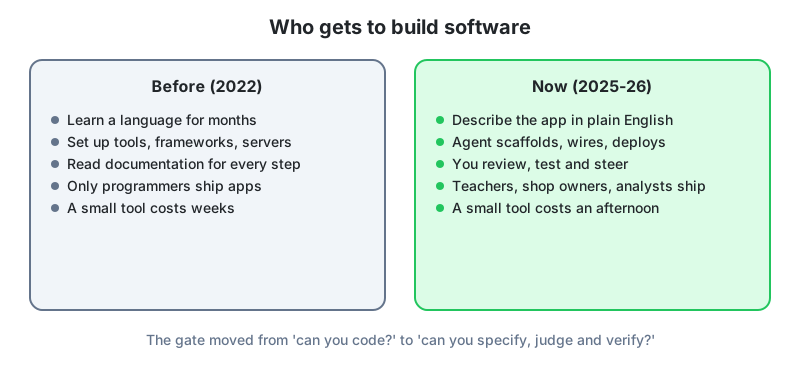
So the gate moved. It used to be "can you code?" Now it's "can you specify what you want, judge what you get, and prove it works?" That's a different skill and a far more common one. Teachers, shop owners, analysts and students have it, or can pick it up, much faster than they could learn a language from scratch.
The loop that actually ships
Vibe coding gets a bad name when it means prompt, accept, prompt, accept until something looks right. That produces demos. The version that produces products has a review step, and we drill it until it's boring.
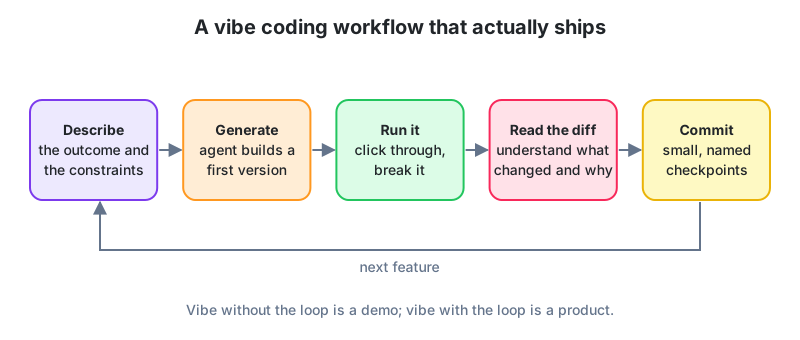
- Describe the outcome, the constraints and what "done" looks like, the way you'd write a ticket for a junior developer.
- Generate. Let the agent build a first version. Ask for a plan first on anything non-trivial.
- Run it. Click through. Try empty inputs, wrong dates, a name with forty characters.
- Read the diff. You don't need every line, but you should know what changed and why. Ask the agent to explain anything unclear.
- Commit a small, named checkpoint so you can always go back.
Then repeat for the next feature. Small steps beat big prompts every time. "Build me a school management system" has failed in our labs every single time someone tried it. "Add a page listing this month's unpaid fees, sorted by class" works.
Where it's a good fit
Internal tools and small products. Fee trackers, inventory sheets with a proper interface, booking forms, dashboards over a spreadsheet, personal projects, prototypes to test an idea before spending money. Clear requirements, few users, failures that are annoying rather than dangerous. Here the speed gain is enormous and the risk is manageable.
It also suits people who can already code. Experienced developers use agents to rush the routine parts and keep their own judgement for architecture, security and the tricky ten percent. For them it isn't a replacement for skill. It's a multiplier on it.
Where it falls over
We see the same three failures in every batch. The demo trap, an app that looks finished but has no validation, no error handling and a database anyone can read. The black box, where the builder can't explain how the app works, so every bug becomes a new prompt and a prayer. And security, because an agent will cheerfully put an API key in the front-end code or skip the server-side permission check if you didn't ask for it.
None of these are reasons to avoid vibe coding. They're reasons to learn a small set of fundamentals alongside it. What a database table is. Where validation has to live. Why secrets never go in Git. How to write and run a test. With those, you can tell the agent to do the right thing and notice when it hasn't. One of our students found a leaked key in her own project in week seven using the checklist, and she was far prouder of that than of the app.
Skills that matter more, and less
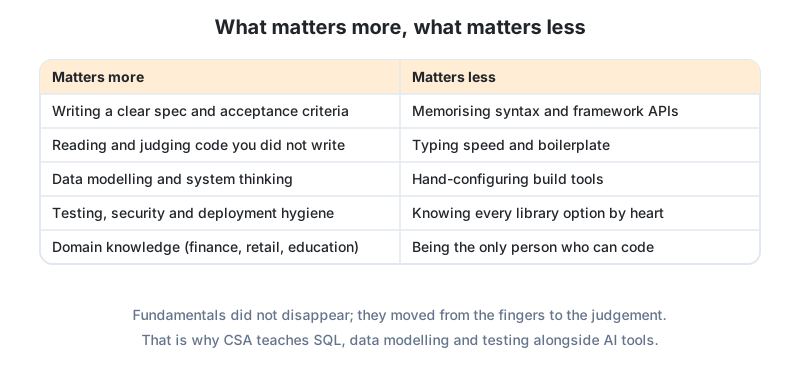
Memorising syntax, typing speed and hand-configuring build tools matter much less. Writing a clear spec, reading code you didn't write, modelling data, testing, deployment hygiene and knowing the business matter much more. Look at that second list. It's mostly what good analysts, product managers and engineers were already doing. The fundamentals didn't vanish. They moved from the fingers to the judgement.
Are developers finished?
No, and so far the evidence points the other way. Demand for software isn't fixed. When building gets cheaper, more gets built, and someone still has to decide what to build, keep it running and fix it at two in the morning. What's changing is the mix. Less time writing routine code, more on design, review, integration, security and talking to users. Junior roles are moving from "write this function" to "own this small feature end to end, with an agent." The developers we know who adopted the tools and kept their fundamentals sharp are busier than ever.
Why this is a real path in Pakistan
We have a young population, a huge freelance workforce and thousands of small businesses that never had custom software because it cost too much. Vibe coding drops that cost hard, and the people best placed to benefit are those who understand a local problem and can build for it. A student who ships a working fee tracker for a tuition centre in Rawalpindi has a portfolio piece and a paying customer in the same week.
The advice that shaped our course is this. Start building immediately, with real users in mind, because the tools reward practice. Learn the fundamentals in parallel rather than first. Databases, APIs, Git, testing and security, each just deep enough to direct an agent and check its work. Ship small things to a public URL, because a live app teaches more than any tutorial. And treat every project as a product, with a user, a failure mode and someone responsible. Clients notice the difference between a person who can prompt and a person who can deliver. If you'd rather try it with a mentor in the room, the vibe-coding course runs on weekends.
Before you close this tab
Vibe coding is describing intent to an agent and steering it. It works now because agents can plan, write, run and fix in a loop, and deployment is one click away. The version that ships includes running the app, reading the diff and committing small checkpoints. Fundamentals separate a demo from a product. And a local business problem plus agent skills plus those fundamentals is a career, not a hobby.