
PhysicalNext start
AIDEV-Weekday-Onsite-3to6
Batch fee
Rs 60,000
Starts
09 Nov 2026
Ends
01 Feb 2027
Class days & time
Monday to Friday, 3:00-6:00 PM · 12 weeks
Mentor
Faisal Adnan
20 seats left0 / 20 enrolled
Enroll by 07 Nov 2026
Plenty of people can paste a prompt into a chatbot. Far fewer can build the thing behind it: clean the data, train and test a model, connect a language model to a company's own documents, and put the result on a server…
Plenty of people can paste a prompt into a chatbot. Far fewer can build the thing behind it: clean the data, train and test a model, connect a language model to a company's own documents, and put the result on a server where it doesn't fall over on the second user. That gap is where the AI developer jobs are, and it's what these twelve weeks are built around.
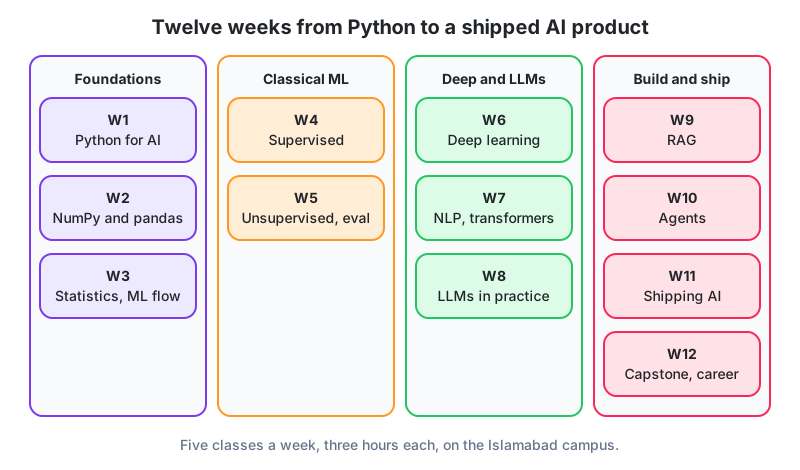
This is an onsite course on our Islamabad campus. You come in five days a week, Monday to Friday, for three hours a day, in either the 3:00-6:00 PM or the 6:00-9:00 PM batch. That's fifteen hours of class a week and 180 credit hours in total, with a mentor in the room for every lab. We start with Python and data handling, move through classical machine learning and deep learning, then spend the second half on language models, retrieval, agents and deployment. The last week is a capstone you build, demo and put on GitHub.
You should be able to write a loop and a function in some language before you start. Python is taught from the level you need in the first two weeks, so you won't be lost, but the pace after that assumes you can keep up with code every day. Expect homework most evenings. Students who treat this like a part-time hobby fall behind by week four, and we'd rather tell you that now.
Batch fee
Rs 60,000
Starts
09 Nov 2026
Ends
01 Feb 2027
Class days & time
Monday to Friday, 3:00-6:00 PM · 12 weeks
Mentor
Faisal Adnan
Enroll by 07 Nov 2026
Batch fee
Rs 60,000
Starts
09 Nov 2026
Ends
01 Feb 2027
Class days & time
Monday to Friday, 6:00-9:00 PM · 12 weeks
Mentor
Faisal Adnan
Enroll by 07 Nov 2026
Week 1 Quiz: Python for AI
Five questions on Python basics, environments and Git. Take it after Day 5 of Week 1.
5 questions
Week 2 Quiz: NumPy and pandas
Five questions on arrays, DataFrames, cleaning and joins.
5 questions
Week 3 Quiz: Statistics and the ML workflow
Five questions on splits, leakage, baselines and metrics.
5 questions
Week 4 Quiz: Supervised learning with scikit-learn
Five questions on models, pipelines and tuning.
5 questions
Week 5 Quiz: Unsupervised learning, features and evaluation
Five questions on clustering, PCA, cross-validation and imbalanced data.
5 questions
Week 6 Quiz: Deep learning foundations
Five questions on the training loop, overfitting and CNNs.
5 questions
Week 7 Quiz: NLP and transformers
Five questions on tokens, embeddings, attention and choosing an approach.
5 questions
Week 8 Quiz: Large language models in practice
Five questions on prompting, structured output, hallucination and safety.
5 questions
Week 9 Quiz: Retrieval-augmented generation
Five questions on chunking, retrieval, reranking and evaluating RAG.
5 questions
Week 10 Quiz: AI agents and tool use
Five questions on agent loops, function calling and guardrails.
5 questions
Week 11 Quiz: Shipping AI
Five questions on APIs, containers, monitoring and privacy.
5 questions
Week 12 Quiz: Capstone, portfolio and career
Five questions on presenting your work and talking about it honestly.
5 questions
Final Assessment: Become an Artificial Intelligence Developer
Thirty questions covering all twelve weeks. You need 70 percent to pass and earn the certificate. You have 75 minutes.
30 questions
Clean and explore a messy business dataset
Take a retail or telecom export with wrong types, duplicates and blanks, clean it with pandas, join it to a second table, and write down every assumption you made. Then check the row count after each join. Someone always finds a silent duplication here.
Hands-on Lab Task
Build a leak-free prediction pipeline
Predict customer churn or loan default with a scikit-learn Pipeline, split the data the right way, compare three models against a dumb baseline and explain which metric you chose and why. Deliberately introduce a leak first and see how good it makes the score look.
Hands-on Lab Task
Train a small neural network in PyTorch
Write the training loop yourself, plot training and validation loss, and fix an overfitting model with early stopping and dropout. No high-level trainer until you have seen what it hides.
Hands-on Lab Task
Classify and search text with Hugging Face
Fine-tune or reuse a small pretrained model on a text classification task, then compare it against a plain prompt on the same examples. Measure both on a held-out set, not on the examples you like.
Hands-on Lab Task
Build a document question-answering assistant
Index a set of English and Urdu circulars, retrieve with embeddings, add a reranking step, return answers with citations, and measure retrieval quality on a list of questions you wrote yourself. Include questions the documents cannot answer.
Hands-on Lab Task
Deploy an AI service with monitoring
Wrap your best model or assistant in a FastAPI app, containerise it with Docker, add request logging and a health check, then deploy it and break it on purpose with bad input to see what your logs tell you.
Hands-on Lab Task
Every batch has one student who says "I know Python" and then loses an hour because a script works on their laptop and nowhere else. Week 1 fixes that habit early. We teach the Python you need for AI work, and we teach it the way a team would use it: in a project folder, in its own environment, under Git.
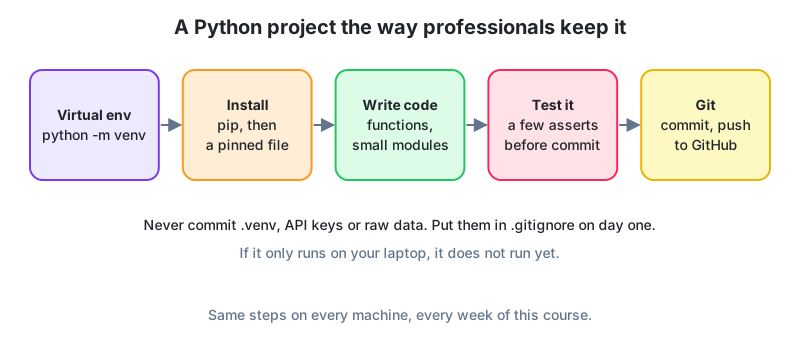
Write a small tool that reads a CSV of shop transactions, totals sales per city and writes a JSON report. Then move it into a package-style folder, give it a virtual environment and push it to GitHub with a README that someone else can follow.
A habit worth stealing: we put
.venvand any file with a key in it into.gitignorebefore the first commit. Removing a leaked API key from Git history is far harder than never committing it.
Your repo link, a requirements file that installs cleanly on a fresh environment, and one function you wrote with a short docstring.
Pick a batch that fits your schedule, then use the enquiry form to reserve your seat.
Batch fee
Rs 60,000
Starts
09 Nov 2026
Ends
01 Feb 2027
Class days & time
Monday to Friday, 3:00-6:00 PM · 12 weeks
Mentor
Faisal Adnan
Enroll by 07 Nov 2026
Batch fee
Rs 60,000
Starts
09 Nov 2026
Ends
01 Feb 2027
Class days & time
Monday to Friday, 6:00-9:00 PM · 12 weeks
Mentor
Faisal Adnan
Enroll by 07 Nov 2026
Faisal Adnan
AI Head @ Peeple Careed
Business Intelligence, Data Warehouse, Artificial IntelligenceFaisal leads CSA's Power BI, Data Warehouse and Vibe Coding programs, bringing a decade of hands-on BI and analytics consulting experience to every weekend batch.
13
Years Experience
14
Batches Taught
3
Students Mentored
No reviews yet, be the first to enroll and share your experience.
Fee by mode