
☰ Learn Artificial Intelligence Tutorial Menu
AI Careers and Skills Roadmap in Pakistan
Written by Faisal Adnan · Updated 26 Sept 2026 · 6 min read
Here's a question a hiring manager at a Karachi bank put to one of our graduates this year. "Show me something you built with AI, and tell me what it got wrong." That question is the whole job market in one line. Banks, telecoms, e-commerce, export software houses, freelancing platforms, and now schools and hospitals are hiring people who can apply AI to real data, and almost none of these roles want a PhD. They want analytics foundations, AI literacy, and proof you've shipped something. Here are the roles, the skills, the local market, and a twelve-month plan.
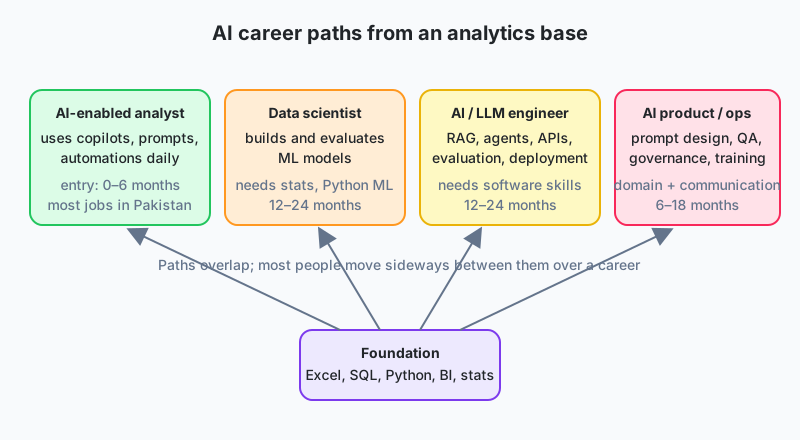
Four paths from an analytics base
| Role | What you do | Core skills | Time from analytics base |
|---|---|---|---|
| AI-enabled analyst | Use copilots, prompts and no-code workflows to deliver analysis faster and better | Excel, SQL, Power BI, prompting, verification, one automation tool | 0–6 months; the largest number of openings |
| Data scientist / ML engineer | Build, evaluate and deploy predictive models on business data | Statistics, Python (pandas, scikit-learn), feature engineering, model evaluation, basic MLOps | 12–24 months |
| AI / LLM engineer | Build RAG systems, agents, tool integrations and evaluation pipelines on top of frontier models | Python, APIs, vector databases, MCP, prompt evaluation, software engineering practice | 12–24 months; strong demand from export-focused software houses |
| AI product, operations or governance | Design prompts and workflows, run quality checks, train staff, own responsible-AI policy | Domain knowledge, communication, testing discipline, ethics and compliance basics | 6–18 months |
Next door sit data engineer (the pipelines that feed AI), annotation and evaluation specialist (growing fast, because human feedback is what models are trained on), and AI trainer or content creator for the local market. We've placed graduates in all three.
The Pakistani market right now
- Banks and fintech (Karachi, Lahore, Islamabad): fraud, credit scoring, customer service automation, regulatory reporting. Value regulated-industry awareness.
- Telecom and mobile wallets: churn, network analytics, chat assistants in Urdu.
- E-commerce and retail: demand forecasting, recommendations, seller support automation, catalogue generation.
- Software houses and freelancing: building RAG chatbots, agents and automations for clients abroad; often the fastest entry point and frequently remote.
- Textiles and manufacturing: vision QC, production planning, export documentation.
- Health and education: triage, records digitisation, tutoring and result analytics; early but growing.
Salaries swing widely by city and employer type. Export-facing and remote roles pay close to international rates, usually in dollars, which is why AI skills are in such demand locally. Whatever the role, employers now ask for a portfolio before a certificate, and the question at the top of this page is becoming standard. Our interview preparation sessions run mock rounds on exactly these questions.
The skills that matter most
| Category | Must have | Good to have |
|---|---|---|
| Data foundations | SQL, Excel, data cleaning, basic statistics | Data modelling, a warehouse tool |
| Programming | Python basics, reading and fixing generated code | Git, APIs, a web framework |
| AI literacy | This track: how models work, limits, prompting, agents, ethics | Reading model documentation and evaluations |
| Tools | One BI tool with AI features, one automation tool, one chat assistant with tools | Vector database, an agent framework, MCP servers |
| Judgement | Verification habits, knowing when not to use AI | Fairness auditing, documentation |
| Communication | Explaining results in Urdu and English to non-technical people | Writing, teaching, presenting |
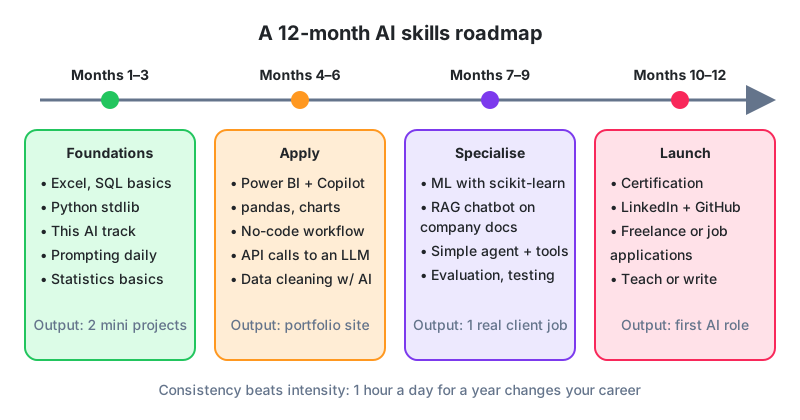
A twelve-month roadmap
- Months 1 to 3, foundations. Finish this AI track and the SQL and Python tracks, and use a chat assistant daily for real tasks. Output is two small projects, for example a sales analysis with AI-drafted SQL that you verified, and a cleaned dataset with the steps written down.
- Months 4 to 6, apply. Learn Power BI with its copilot features, pandas, and one automation tool. Build the triage workflow from the last lesson for a real shop or a friend's business. Output is a public portfolio (GitHub plus a simple site) with three projects and write-ups.
- Months 7 to 9, specialise. Pick a path. Data science means scikit-learn models with proper evaluation. AI engineering means a RAG chatbot on real documents, then a small agent with two tools and a test set. Product or ops means a prompt library with tests and a responsible-AI checklist. Output is one real client or employer project, paid or not.
- Months 10 to 12, launch. Certification if your target employers care, a polished LinkedIn and GitHub, applications and freelance profiles, and teaching what you learned (a blog post, a workshop at your college). Output is your first AI role or paid contract.
The step people skip is teaching. Every graduate who ran a workshop at their old college got at least one interview out of it.
Turning a project into a portfolio entry
A portfolio entry is a story with evidence. Every student fills in this template per project, and yes, the evidence line is the hard one.
Title:        WhatsApp order triage for a Lahore clothing seller
Problem:      150 messages/day, urgent complaints missed for hours
What I built: Make workflow + LLM classification (JSON output) + Sheets + review queue
Evidence:     accuracy 92% on 40 labelled messages; review queue 8%; urgent alerts < 1 min
My role:      designed prompt and guardrails, built and tested the flow, trained the owner
What I learned: Roman Urdu examples mattered more than model choice
Link:         GitHub repo with prompt, test set and screenshots (customer data removed)
Recruiters skim hundreds of "completed a course in AI" lines a week. They stop at a number and a link.
From accounts assistant to analytics lead, part-time. A commerce graduate in Rawalpindi followed this roadmap around a full-time job. Months 1 to 6 were SQL, Python, this track, and a Power BI dashboard for her employer's receivables with an AI-drafted narrative she corrected monthly. Months 7 to 9 were a RAG assistant over the company's policy PDFs, tested against 30 questions. In month 11 she was promoted to finance analytics lead, and picked up a weekend contract building the same thing for a school. No new degree. One strong portfolio and a clear answer to "what did it get wrong".
Quick recap
- Four paths open from an analytics base, and the AI-enabled analyst role has the most openings and the quickest entry.
- Banks, telecoms, e-commerce, export software houses and freelancing are the main employers in Pakistan.
- Foundations, Python, AI literacy, tools, judgement and communication are the six pillars.
- Follow a twelve-month plan with concrete outputs. A portfolio with numbers beats a list of certificates.
Try this before the next lesson
- Pick your path and write down the three skills from the table you are weakest in, with one resource for each.
- Write a portfolio entry using the template for something you have already done, even if it was small.
- Find three current AI-related job adverts in Pakistan and map each requirement to a lesson in this track or another CSA track.
Lesson 17 of 18
Sign in to track your progress and earn XP for every lesson you finish.