
☰ Learn Artificial Intelligence Tutorial Menu
Generative AI: Text, Images, Audio and Video
Written by Faisal Adnan · Updated 26 Sept 2026 · 5 min read
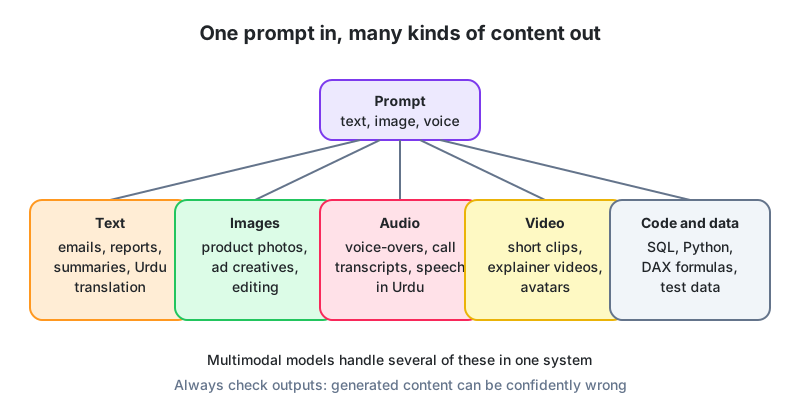
A Daraz seller in Lahore once showed us a product description an AI had written for her lawn suits. It was lovely. It also promised "pure silk" for a cotton suit, and it had been live for a week. That one line sums up generative AI for a working analyst. Until recently AI mostly recognised things (this is spam, this is a cat, this transaction looks risky). Generative AI makes new things: a paragraph, a product photo, a voice-over, a short video, a working SQL query. It now sits inside office tools, design apps and marketing platforms. Here's how each kind works and how it goes wrong.
Recognising versus creating
| Discriminative model | Generative model | |
|---|---|---|
| Learns | The boundary between categories | The distribution of the data itself |
| Output | A label or score | A new sample: text, image, audio |
| Example | "This review is negative (0.93)" | "Write a polite reply to this negative review" |
| Risk | Wrong label | Plausible but false content |
Text
LLMs write by predicting tokens, as you saw last lesson. They now draft emails, reports, code, formulas and translations as a matter of routine, and reasoning models handle multi-step analysis. Quality depends heavily on the prompt (that's the next lesson) and on handing the model the facts it needs rather than hoping it knows them.
Images
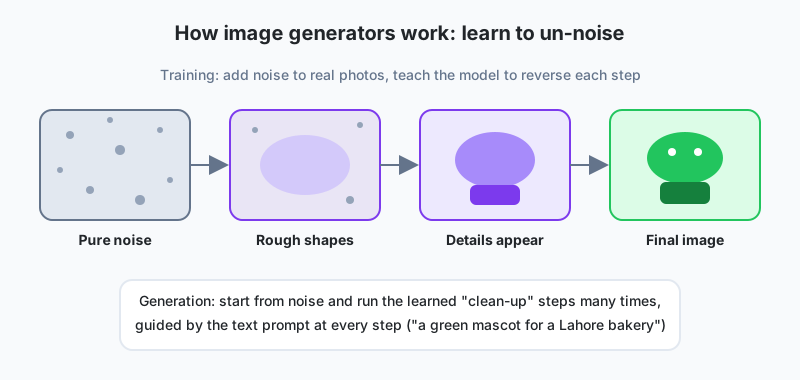
Most image generators use diffusion. During training the model watches real images being slowly destroyed with random noise and learns to undo each step. To generate, it starts from pure noise and repeatedly "cleans" it, steered by your text prompt at every step, until a coherent picture appears. The same models edit, too. Swap the background of a product photo, extend a banner, restyle a logo.
Audio
Text-to-speech now produces natural voices in many languages, Urdu included, and can clone a voice from a short sample, which is exactly why voice scams have grown. Speech-to-text transcribes calls and meetings, and paired with an LLM it hands you a summary and action items. Music generation exists but rarely comes up in business work.
Video
Video models stretch diffusion across time, producing a run of consistent frames from a text or image prompt. As of 2026 they make short, convincing clips good enough for adverts and explainers, while long consistent scenes are still hard. Avatar tools animate a presenter reading a script, and a few training departments in Islamabad have adopted them.
Multimodal models
Frontier models are increasingly multimodal. One system takes text, images, audio and documents in and gives text, images and speech out. For you this means photographing a handwritten stock sheet, asking for a clean table, then asking for a chart, all in one conversation. We do this in class with a photo of an attendance register and it always gets a reaction.
Where it goes wrong
- Hallucination. Fluent, confident and false. Invented statistics, fake references, formulas that look right.
- Inconsistency. The same prompt gives a different answer next time. Images have six fingers or Urdu text that's gibberish.
- Copyright and ownership. Training data and generated output raise legal questions that differ by country and aren't settled.
- Deepfakes and fraud. Cloned voices and faces used in scams. Any payment authorised by voice or video now needs a second check.
A safe first use: synthetic test data
One of the most useful and least risky generative jobs for an analyst is making realistic test data. The plain Python below writes a small synthetic orders file with believable Pakistani cities, products and prices, the sort of thing you'd ask an LLM for, done deterministically so you can trust every row.
import csv, random
from datetime import date, timedelta

random.seed(7)
cities   = ["Karachi", "Lahore", "Islamabad", "Faisalabad", "Peshawar", "Multan"]
products = [("Lawn suit", 3500), ("Power bank", 2200), ("Basmati 5kg", 1900), ("Kids shoes", 1500)]

with open("synthetic_orders.csv", "w", newline="") as f:
    w = csv.writer(f)
    w.writerow(["order_id", "order_date", "city", "product", "qty", "unit_price"])
    for i in range(1, 51):
        name, price = random.choice(products)
        d = date(2026, 1, 1) + timedelta(days=random.randint(0, 89))
        w.writerow([i, d.isoformat(), random.choice(cities), name,
                    random.randint(1, 4), round(price * random.uniform(0.9, 1.1))])
print("wrote synthetic_orders.csv")
When you ask an LLM for the same thing, spell out the columns, ranges and row count, and check the output before you use it. Models drift from the requested format halfway through more often than you'd think, especially past fifty rows.
How the lawn-suit seller fixed it. She kept generative AI across the whole funnel. An image model makes lifestyle photos of each design on different backgrounds (a person checks the fabric colour), an LLM writes descriptions in English and Roman Urdu from a spec sheet, and text-to-speech voices a 30-second TikTok ad. What changed after the silk incident was one rule. Every generated claim about fabric, size or delivery time is checked against the real listing before it goes live. That rule is worth more than any model upgrade.
If you remember one thing
Generative models create, discriminative models classify. Text comes from next-token prediction, images and video from diffusion, audio from speech models, and multimodal models stitch them together. The risks are hallucination, inconsistency, copyright and deepfakes, and the answer to all of them is verification. Synthetic data, first drafts and creative variants are where an analyst gets the most value for the least risk.
Homework
- Extend the synthetic data script with a "status" column (delivered, returned, cancelled) using realistic proportions, then compute the return rate by city.
- Ask an image generator for a product photo with Urdu text on the packaging. What goes wrong, and why does it happen?
- List three generative uses for a Rawalpindi school (for example, exam question variants) and the verification step each one needs.
Lesson 10 of 18
Sign in to track your progress and earn XP for every lesson you finish.