
☰ Learn Artificial Intelligence Tutorial Menu
What is Artificial Intelligence?
Written by Faisal Adnan · Updated 26 Sept 2026 · 5 min read
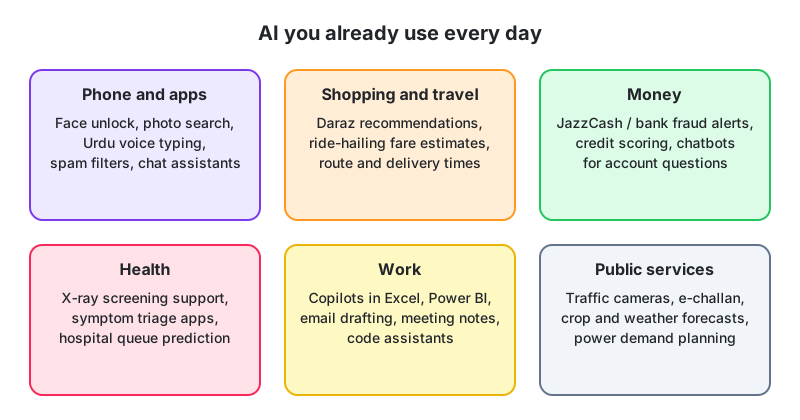
Your phone opens when it sees your face. Your bank texts you about a "suspicious transaction" while you're still at the counter. A chat assistant tidies your CV. Which of those is AI? All three, which surprises plenty of students in our first weekend session, because they picture AI as a robot. Let's build a definition you can use at work.
A working definition
Artificial intelligence means building software that does tasks which normally need human judgement. Recognising a face, reading a sentence, predicting what happens next, deciding what to do. The word that matters is tasks. AI isn't a brain in a box, it's a bag of techniques for getting useful behaviour out of a computer.
Most modern AI shares one idea. Instead of a programmer typing every rule, the system learns the patterns from data. Nobody handed your spam filter a list of every spam message. It saw thousands of examples marked "spam" and "not spam" and worked out the pattern itself.
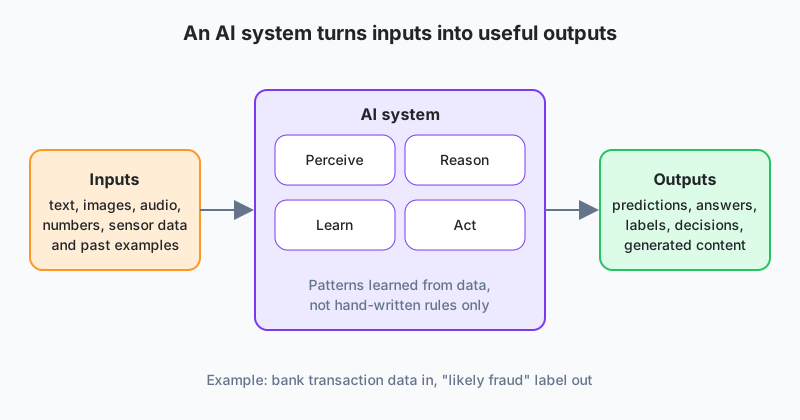
Four things an AI system can do
| Ability | What it means | Example |
|---|---|---|
| Perceive | Turn raw input (pixels, sound, text, numbers) into something structured | Reading the amount on a scanned JazzCash receipt |
| Reason | Combine facts and rules to reach a conclusion | Deciding a transaction is risky because it is at 3 a.m. from a new device |
| Learn | Improve from experience or examples | Getting better at spotting fraud as new cases are confirmed |
| Act | Produce an output that changes something | Blocking the transaction and sending an alert |
Not every system does all four. A calculator reasons but never learns. A photo tagger perceives and learns but doesn't act. Frontier models from Anthropic, OpenAI and Google do all four, which is why they feel different. They read documents and images, reason in steps, learned from feedback during training, and act by calling tools such as databases and browsers.
What AI is not
- Not conscious. A language model predicts likely words. It doesn't want anything, however friendly it sounds.
- Not always right. These systems are statistical, and they sound just as confident when wrong. You'll hear the word hallucination a lot.
- Not one thing. "AI" covers 1980s rule engines, machine learning, deep networks and today's large language models. We'll pull those apart over the next few lessons.
Is this AI? A quick test
Ask one question of each system. Does it learn patterns from data, or do a job that would otherwise need a person's judgement?
| System | AI? | Why |
|---|---|---|
| Excel formula that sums a column | No | Fixed arithmetic rule, no judgement or learning |
| Bank rule: "block if amount > 500,000 PKR" | Borderline | A hand-written rule. Old "expert systems" called this AI; today most people would not |
| Model that scores each transaction 0–1 for fraud risk, trained on past cases | Yes | Learned from data, performs judgement |
| Chat assistant that drafts an email in Urdu | Yes | Language understanding and generation learned from text |
| Camera that reads number plates at a toll plaza | Yes | Computer vision recognising characters |
The Python below is the smallest example we know of "the data chooses the rule". It tries every past amount as a cut-off and keeps the one that best separates the fraud cases.
past = [(120000, 0), (450000, 0), (900000, 1), (300000, 0), (1500000, 1), (800000, 1)]
# (amount in PKR, was_fraud)

best = None
for threshold in sorted(a for a, _ in past):
    correct = sum((a >= threshold) == bool(f) for a, f in past)
    if best is None or correct > best[1]:
        best = (threshold, correct)

print("learned threshold:", best[0], "correct:", best[1], "of", len(past))
# learned threshold: 800000 correct: 6 of 6
Real models learn thousands of thresholds and combinations at the same time, but the idea never changes. The data picks the rule, not the programmer.
What a Karachi fraud team learned the hard way. A bank's fraud unit we spoke with ran on about forty hand-written rules. Within months the fraudsters had worked them out (always staying just under the amount limit, for one). The team replaced the rules with a model trained on two years of confirmed cases. It scores each card transaction in milliseconds, catches patterns nobody had written down, and is retrained monthly as new tricks appear. The analysts didn't disappear. They review the borderline cases and feed confirmed outcomes back into training, a job description you'll see again and again in this track.
Why an analyst should care
You won't need to build a model to feel this. Every tool we teach now ships with an assistant. Excel and Power BI have copilots that write formulas and explain charts, SQL editors suggest queries, and a chat assistant will summarise a fifty-page report before your tea goes cold. The students who get the most out of these tools aren't the fastest typists. They're the ones who understand what's underneath, because they know what to check. That's what this track is for.
If you remember one thing
AI is software that does judgement tasks by learning patterns from data. It can perceive, reason, learn and act, though most systems only manage some of those. And it's statistics, not magic, so it can be confidently wrong. Keep that sentence in your head for the next seventeen lessons.
Try this before the next lesson
- List five apps on your phone and mark which ones use AI and for what task (perceive, reason, learn or act).
- Take the Python example and add three more past transactions. Does the learned threshold change? Why?
- Write two sentences explaining to a shop owner in Rawalpindi the difference between a "rule" and a "model" for detecting fake orders.
Lesson 1 of 18
Sign in to track your progress and earn XP for every lesson you finish.