
☰ Learn Artificial Intelligence Tutorial Menu
Types of AI: Narrow, General and the Capability Ladder
Written by Faisal Adnan · Updated 26 Sept 2026 · 5 min read
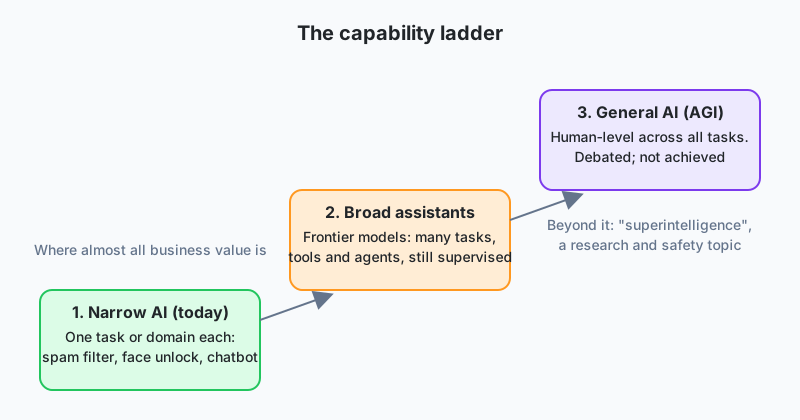
A student in one of our batches once asked whether the fraud model at his bank could be "upgraded" to answer customer emails. It sounds reasonable and it's completely wrong, and why it's wrong is the point of this lesson. "AI" is not one thing with a dial from dumb to smart. Here's a three-rung ladder for placing any system, from a spam filter to a frontier reasoning model, and judging the claims made about it.
Rung 1: narrow AI
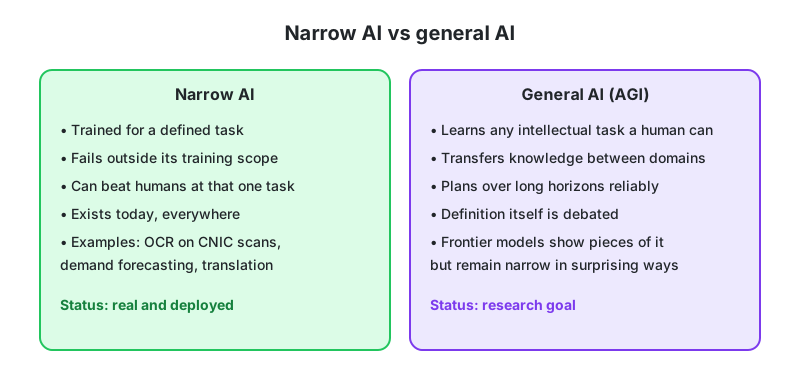
Narrow AI is built or trained for one task or one domain. It can be superhuman at that task and useless one step outside it. A chess engine can't read an X-ray. The model that opens your phone with your face can't forecast sales. Almost every AI system running in Pakistan today sits on this rung, including that bank's fraud model.
- Fraud scoring at banks and mobile wallets
- Product recommendations on Daraz
- Number-plate recognition on motorways
- Demand forecasting at retail chains
- Urdu speech-to-text on phones
Rung 2: broad assistants (today's frontier models)
Frontier models such as Claude, GPT and Gemini are the odd ones out. One model writes code, summarises contracts, describes images, works through maths and, given tools, operates software. That breadth is why some people call them "general". But they still fail in ways no person would. They miscount the letters in a word, invent a court case, lose the thread of a long plan. We call them broad but uneven. Wide coverage, unpredictable gaps, and a human still checking anything that matters.
Rung 3: artificial general intelligence (AGI)
AGI would learn and perform any intellectual task a person can, carry knowledge between domains, and improve itself reliably. There's no agreed test for it and it doesn't exist. Beyond that, superintelligence would beat the best humans at nearly everything. Interesting for research and safety policy, irrelevant for your business plan.
Other useful ways to slice it
| Axis | Categories | Example |
|---|---|---|
| By approach | Rule-based (symbolic) vs learned (machine learning) | Tax calculator vs credit-risk model |
| By output | Discriminative (labels, scores) vs generative (new content) | Spam classifier vs image generator |
| By modality | Text, vision, speech, tabular, multimodal | OCR is vision; an LLM is text; frontier assistants are multimodal |
| By autonomy | Assistive (suggests) vs autonomous (acts) | Copilot drafting a formula vs an agent reconciling invoices |
| By memory | Reactive (no memory) vs stateful (remembers context) | A single prediction vs a multi-turn assistant with project memory |
The axis that matters most right now: autonomy
The biggest practical change of the last two years isn't intelligence, it's autonomy. An assistive tool suggests and you decide. An agent plans, calls tools, checks the result and keeps going until the job is done. The same model can be either, depending on how it's wired up. So when someone shows you an AI product, ask them what it can do without a human clicking approve. The answer tells you how much testing and control you'll need.
Placing real systems on the ladder
System                                    Rung   Autonomy    Modality
------------------------------------------------------------------------
K-Electric load forecasting model         1      assistive   tabular
CNIC OCR at a bank branch                 1      autonomous  vision
WhatsApp reply suggestions                1      assistive   text
Chat assistant summarising a PDF          2      assistive   multimodal
Agent that files monthly FBR data         2      autonomous  text + tools
Hypothetical system that learns any job   3      n/a         any
Notice that "autonomous" has nothing to do with being high on the ladder. A narrow OCR system runs without approval because its mistakes are cheap to catch. An agent filing tax data needs a human in the loop because its mistakes are expensive.
Reading marketing with the ladder
Brochures rarely map onto the ladder honestly. "Powered by AI" usually means a rung-1 model, or fixed rules. "Generative AI" means a rung-2 model is in there somewhere, often only as the chat window. "Autonomous" should make you ask what it does without approval and what happens when it's wrong. A habit we drill in class is to rewrite every claim as "a [rung] system that [does task] with [autonomy level] on [modality] data". If you can't fill the blanks from the vendor's material, ask for a demo on your data, not theirs.
How a Rawalpindi school split one vague request into three. A private school asked a vendor for "an AI to manage results". Their data officer, a graduate of ours, used the ladder to break it apart. OCR to read paper answer sheets (rung 1, autonomous, vision). A model to flag students at risk of failing from attendance and marks (rung 1, assistive, tabular). A chat assistant teachers can ask in Urdu about class trends (rung 2, assistive, text plus a database tool). Each piece could be bought, tested and explained on its own, and the school never bet on a "general" system that doesn't exist.
Before you move on
- Narrow AI does one task well, and that's where almost all the business value sits today.
- Frontier models are broad but uneven. They are not AGI.
- Sort systems by approach, output, modality, autonomy and memory, not just "AI or not".
- Autonomy decides how much control and testing you need.
Three things to try
- Place five AI features you use (for example, Gmail smart reply, Daraz search, bank fraud SMS) on the ladder and the autonomy axis.
- A vendor claims their chatbot is "AGI-powered". Write three questions you would ask to test the claim.
- For a JazzCash-style wallet, list one assistive and one autonomous AI use, and explain which needs more human review.
Lesson 3 of 18
Sign in to track your progress and earn XP for every lesson you finish.