
☰ Learn Artificial Intelligence Tutorial Menu
Glossary and Practice Questions
Written by Faisal Adnan · Updated 26 Sept 2026 · 8 min read
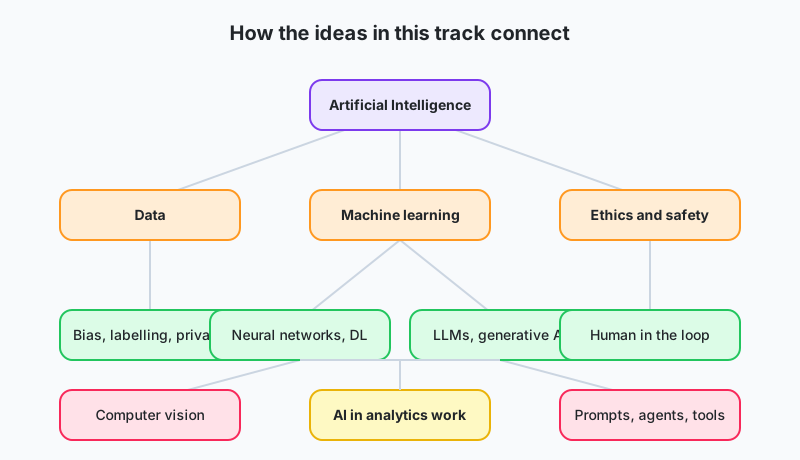
One page, and you'll have every term this track used, in a form you can revise on the bus. Below is a forty-term glossary, a concept map, and fifteen practice questions with answers. Do the questions before you read the answers (we know, everyone peeks). Each answer points back to the lesson to reread if you missed it.
Glossary
| Term | Meaning |
|---|---|
| Artificial intelligence (AI) | Software that performs tasks needing human-like intelligence, usually by learning from data. |
| Machine learning (ML) | Methods that learn patterns from data instead of following hand-written rules. |
| Deep learning (DL) | Machine learning using neural networks with many layers; best for images, audio and text. |
| Narrow AI | AI built for one task or domain; almost all deployed AI today. |
| AGI | Hypothetical AI that can learn and perform any intellectual task a human can. |
| Model | The learned rules (weights) produced by training; used to make predictions on new data. |
| Training | Adjusting a model's weights to reduce error on example data. |
| Weights / parameters | The numbers inside a model that training adjusts. |
| Loss | A number measuring how wrong the model's predictions are; training tries to reduce it. |
| Gradient descent | The step-by-step method of nudging weights in the direction that lowers the loss. |
| Epoch | One full pass through the training data. |
| Supervised learning | Learning from inputs paired with correct answers (labels). |
| Unsupervised learning | Finding structure (clusters, anomalies) in data without labels. |
| Reinforcement learning | Learning by trial and error from rewards and penalties. |
| Label | The correct answer attached to a training example. |
| Feature | An input variable to a model, such as amount, city or hour. |
| Overfitting | A model that memorises training data and performs poorly on new data. |
| Train / validation / test split | Dividing data so the model is tuned and evaluated on data it has not seen. |
| Precision | Of the items the model flagged, the share that were truly positive. |
| Recall | Of all truly positive items, the share the model caught. |
| Neuron | A unit that computes a weighted sum plus bias and applies an activation function. |
| Activation function | A non-linear "squash" (ReLU, sigmoid) that lets networks model curves. |
| Backpropagation | The algorithm that works the output error backwards to update every weight. |
| CNN | Convolutional neural network; slides filters over images to detect patterns. |
| RNN | Recurrent neural network; processes sequences step by step with a carried memory. |
| Transformer | Architecture using attention so every token can look at every other token in parallel; basis of LLMs. |
| Attention | Mechanism that weights how much each token matters to another token's meaning. |
| Token | A chunk of text (roughly 3–4 characters) that a language model reads and writes. |
| Large language model (LLM) | A transformer trained on huge text to predict the next token; powers chat assistants. |
| Context window | The maximum number of tokens a model can consider at once. |
| Knowledge cut-off | The date after which a model's training data contains nothing. |
| Embedding | A vector of numbers representing the meaning of text or an image; similar meanings are close. |
| Hallucination | Fluent, confident output that is false. |
| Prompt | The instruction and context given to a language model. |
| Few-shot prompting | Including examples of inputs and desired outputs in the prompt. |
| Reasoning model | An LLM trained to work through intermediate steps before answering, spending more compute on hard problems. |
| Tool use / function calling | A model producing structured calls to external functions (SQL, APIs) whose results it then uses. |
| Agent | A system where a model plans, calls tools, observes results and repeats until a goal is met. |
| RAG | Retrieval-augmented generation: fetching relevant documents into the prompt so the model answers from them. |
| MCP | Model Context Protocol: an open standard for connecting AI applications to tools and data sources. |
| Prompt injection | Hidden instructions in content an AI reads, intended to hijack its behaviour. |
| Human in the loop | A design where a person reviews or approves AI output before it takes effect. |
Practice questions
Try each one out loud, as if an interviewer had asked it, then compare with the answer. Questions 5, 11 and 13 come up most in real interviews.
1. A bank blocks transactions above 500,000 PKR using a fixed rule. Is this machine learning?
Answer: No. The rule was written by a person, not learned from data. It is rule-based automation; some would call it old-style AI. (Lesson 1, 4)
2. Why did the AI winters happen, and what changed in 2012?
Answer: Promises outran computing power and data, so funding was cut. By 2012 large labelled datasets, GPUs and better training tricks let deep networks win decisively on image recognition. (Lesson 2)
3. Place "a frontier chat assistant with tools" on the capability ladder and explain why it is not AGI.
Answer: Rung 2, broad assistant. It handles many tasks but fails in ways no human would and needs supervision; it does not reliably learn any task or transfer knowledge like a person. (Lesson 3)
4. Draw the relationship between AI, ML and DL in one sentence.
Answer: Deep learning is a subset of machine learning, which is a subset of artificial intelligence: DL ⊂ ML ⊂ AI. (Lesson 4)
5. A model scores 99% accuracy on fraud detection where 0.5% of transactions are fraud. Why is this misleading and what should you report?
Answer: Predicting "not fraud" always would score 99.5%. Report precision (flagged transactions that were fraud) and recall (fraud that was caught). (Lesson 5)
6. Why should time-series data be split by date rather than randomly?
Answer: A random split leaks future information into training, giving optimistic results that do not hold when forecasting genuinely unseen periods. (Lesson 6)
7. Describe the bias feedback loop and one way to break it.
Answer: Biased historical data trains a model, the model makes biased decisions, those decisions create new data that confirms the bias, and retraining strengthens it. Break it by auditing outcomes per group, collecting data from under-represented groups and keeping human review. (Lesson 6, 15)
8. Write the formula for a single neuron and name the three parts training adjusts.
Answer: y = f(w1·x1 + w2·x2 + ... + b). Training adjusts the weights (w) and the bias (b); the activation f is chosen by the designer. (Lesson 7)
9. Why can a single neuron learn AND but not XOR?
Answer: A single neuron draws one straight boundary. AND is separable by one line; XOR is not, so a hidden layer is needed. (Lesson 7)
10. In "The invoice from the supplier was rejected because it was unsigned", which word should "it" attend to most, and which mechanism does this?
Answer: "invoice". The attention mechanism in a transformer weights the relevant token highly. (Lesson 8)
11. An assistant confidently states this year's FBR tax slab, but it is wrong. Name two likely causes and two fixes.
Answer: Causes: knowledge cut-off (the slab changed after training) and hallucination (fluent guessing). Fixes: provide the current document in the prompt or via RAG, and instruct the model to cite sources and say when unsure. (Lesson 9, 11)
12. Rewrite "summarise this" as a strong prompt for a board pack.
Answer: Include role (financial analyst), context (the pack and metric definitions), task (summarise for the board), format (five bullets then three risks), constraints (PKR, no speculation, flag missing data). (Lesson 11)
13. What is the difference between a chatbot and an agent, and which guardrails does an agent need?
Answer: A chatbot answers once; an agent plans, calls tools, observes and repeats until the goal is met. Guardrails: step and cost limits, least-privilege tools, human approval for irreversible actions, logging, and treating external content as data to resist prompt injection. (Lesson 12)
14. A fabric-defect detector can use a threshold of 0.5 or 0.9. Which gives higher recall, and when would you choose it?
Answer: 0.5 flags more segments, so recall is higher and precision lower. Choose it when a missed defect is far more costly than a false alarm, as for export orders. (Lesson 13)
15. Describe "AI drafts, analyst verifies, business decides" with one concrete verification step.
Answer: The AI produces the query, chart or summary; the analyst checks it (for example, reconciling the AI-generated revenue total with last month's finance ledger); the business owner makes the decision and is accountable. (Lesson 14, 15)
What set one graduate apart. A CSA graduate interviewing for an analyst role at an Islamabad telecom was asked to explain, in plain words, why the company's churn model should be retrained and how she'd know it was fair. She used the glossary without sounding like one. The training data pre-dated a new pricing plan, the model was probably overfitting to old behaviour, and she'd compare recall per city and per plan before and after retraining. The interviewer told us afterwards that the clear vocabulary, not a flashy project, got her the offer.
If you remember one thing
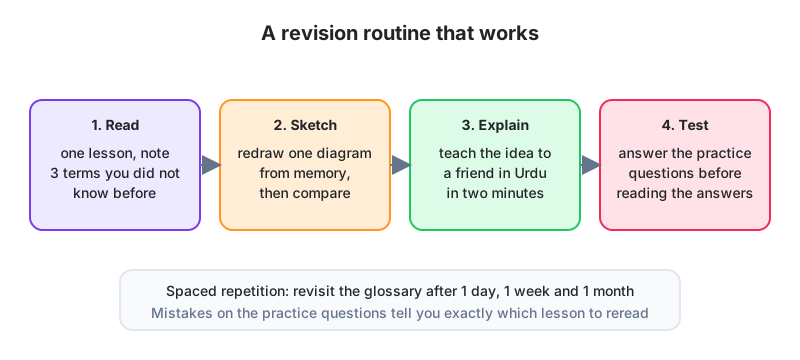
Forty terms cover the vocabulary you'll meet in job adverts, vendor pitches and documentation, and the concept map tells one story. Data feeds learning, learning produces models, models need ethics and human oversight, and analysts apply all of it. Revise by reading, sketching the diagrams from memory, explaining them to a friend and testing yourself, spaced over a few weeks rather than crammed into one night. When you're ready to prove it, the certification exam draws on exactly this list.
Three things to try
- Without looking, write definitions for ten glossary terms chosen at random, then check them.
- Redraw the concept map adding one Pakistani example next to each node.
- Write five new practice questions of your own, one each from lessons 10, 12, 14, 16 and 17, with model answers.
Lesson 18 of 18
Sign in to track your progress and earn XP for every lesson you finish.