
☰ Learn Artificial Intelligence Tutorial Menu
A Short History of AI: From Turing to Transformers
Written by Faisal Adnan · Updated 26 Sept 2026 · 5 min read
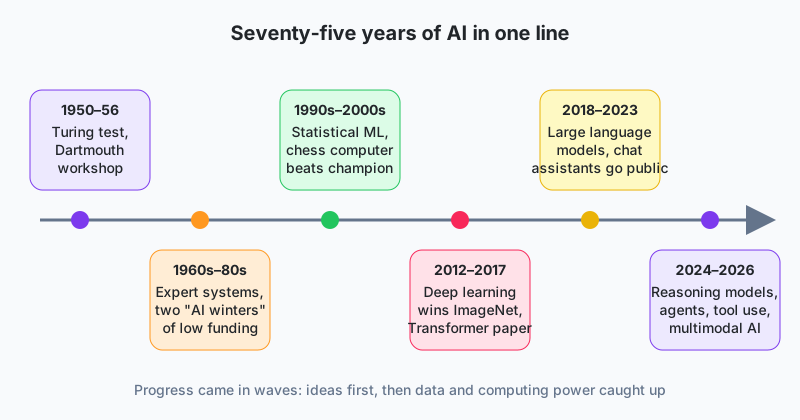
A vendor walks into a Faisalabad textile mill and calls their forecasting tool "brand new AI". Half the time it's a 1990s method with a chat box on top, which is fine, because 1990s methods are often the right answer. You can only tell if you know the story. AI has boomed and busted twice, and every wave left tools behind. Here's the timeline from 1950 to 2026, kept to the ideas that still matter.
1950 to 1956: the founding questions
In 1950 Alan Turing asked "Can machines think?" and proposed the imitation game, now called the Turing test. If a judge chatting by text can't tell the machine from a person, we may as well say the machine thinks. In 1956 a summer workshop at Dartmouth College gave the field its name. Researchers expected human-level machines within a generation. They've been "just around the corner" ever since.
1960s to 1980s: symbolic AI and expert systems
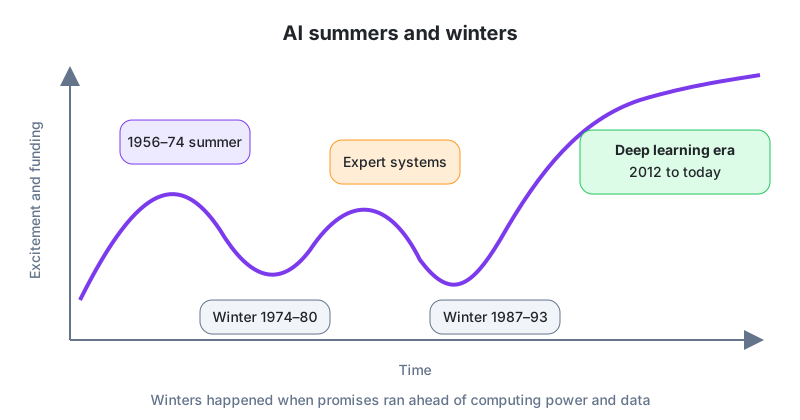
The first approach was symbolic AI. Write knowledge down as rules and let the computer reason with logic. Expert systems captured a doctor's or an engineer's know-how as hundreds of "if this, then that" statements. They worked in narrow fields, but they were brittle and expensive to maintain, and when the promises went unmet the funding dried up. Those droughts are the AI winters, roughly 1974 to 1980 and 1987 to 1993.
1990s to 2000s: statistics wins
Researchers gave up on writing rules and started learning them from data. Decision trees, support vector machines and Bayesian models quietly ran spam filters, credit scoring and search engines. In 1997 a chess computer beat the world champion, mostly by brute-force search plus hand-tuned scoring. Superhuman at one narrow thing, no general intelligence needed. Remember that pattern.
2012 to 2017: deep learning takes over
Three things landed at once. Huge labelled datasets (millions of internet images), cheap parallel computing on GPUs built for games, and better training tricks for multi-layer networks. In 2012 a deep convolutional neural network crushed the ImageNet contest, and within a few years deep learning owned speech recognition, translation and vision. Then in 2017 the Transformer was published. Its "attention" mechanism let models handle long text in parallel, and everything you use today is built on it.
2018 to 2023: large language models
Train a transformer on a big slice of the internet and you get a large language model (LLM) that writes, summarises, translates and codes. Making the model, the data and the compute bigger kept improving results, a pattern called scaling laws. Late 2022 brought public chat assistants, and for the first time hundreds of millions of ordinary people used AI directly.
2024 to 2026: reasoning, agents and multimodality
The newest wave changed how models are used more than how big they are. We use every row of this table in our own work at CSA.
| Shift | What changed | Why it matters for analysts |
|---|---|---|
| Reasoning models | Models trained to "think" through a problem in steps before answering, spending more compute on hard questions | Better at maths, logic, multi-step data questions and debugging code |
| Tool use and agents | Models call databases, spreadsheets, web browsers and code runners, then loop until a task is done | An assistant can query your sales table, draw the chart and email it |
| Standard connectors (MCP) | The Model Context Protocol lets any assistant plug into any tool through one open standard | Power BI, CRM and file systems become reachable by the same assistant |
| Multimodal models | One model reads text, images, audio and video, and can generate several of them | Photograph a handwritten invoice, get a clean table |
| AI inside business tools | Copilots built into Excel, Power BI, email, CRM and ERP software | AI becomes a feature, not a separate app |
Back to the vendor in Faisalabad
Now you can ask sharper questions. We give students this list to take into meetings.
- Is it a statistical model (1990s methods, still excellent for monthly sales) or a deep model that needs far more data than we have?
- Does it learn from our data, or apply fixed rules in the 1980s expert-system style?
- If there's an LLM involved, is it a chat layer on top of a normal forecast, or is the LLM doing the arithmetic? (The second one should worry you.)
The method has to match the data and the problem. A mill with 36 months of sales history is nearly always better served by a simple statistical model than a huge neural network, whatever the brochure says.
Every era, still running in one Lahore company. A logistics firm we know adopted "AI route planning" in 2016. It was a rule engine, and it fell over whenever a road closed. In 2020 they moved to a machine-learning model trained on their own GPS history, and fuel costs came down. In 2025 they added an LLM assistant that dispatchers talk to in Urdu; it calls the routing model as a tool and explains the plan. All three eras are still in the stack. Rules for legal constraints, ML for optimisation, an LLM for the conversation.
Quick recap
The winters came when promises outran data and compute. The big turn was from hand-written rules to learning from data, then deep learning in 2012 and the Transformer in 2017. The 2024 to 2026 wave added reasoning, tool use, agents, MCP and multimodal input. None of the older methods went away, because the right tool still depends on your data and your problem.
Homework
- Draw your own version of the timeline with one Pakistani example per era (for example, when did local banks start using automated fraud scoring?).
- Explain in three sentences why the two AI winters happened and what was different in 2012.
- Pick one tool you use (Excel, WhatsApp, Daraz) and identify which era of AI technology its "smart" features most likely come from.
Lesson 2 of 18
Sign in to track your progress and earn XP for every lesson you finish.